In today’s hyperconnected world, data flows freely across clouds, apps, and devices. While this drives collaboration and agility, it also exposes organizations to unprecedented risk. Traditional Data Classification and Data Loss Prevention (DLP) methods rely on rigid policies — regex patterns, keywords, and static rules. But as data volume explodes and employees use generative AI tools, cloud file shares, and unmanaged channels, static DLP simply can’t keep up.
Organizations need smarter, adaptive protection — and AI is the key.
2️⃣ AI-Powered Data Classification: Context Over Keywords
AI, powered by Natural Language Processing (NLP), is transforming how we understand and protect data. Instead of relying solely on fixed dictionaries, AI models can interpret context, intent, and sensitivity.
For example:
A traditional DLP might classify any document with the word “confidential” as high-risk.
An AI-driven system recognizes why it’s confidential — financial data vs. a routine email footer.
This shift to contextual classification means fewer false positives, better accuracy, and more trust in automated controls.
3️⃣ Smarter, Adaptive DLP with Machine Learning
Machine learning takes DLP beyond basic policy enforcement. AI can now learn user behavior patterns — what data employees typically access, send, or store. When anomalies occur (like an HR analyst downloading gigabytes of source code), AI can trigger dynamic responses:
Temporary file quarantine
Automated policy alerts
Access revocation or MFA challenges
The result is adaptive DLP — protection that evolves in real time based on risk.
4️⃣ AI, Privacy, and Responsible Data Governance
As AI becomes integral to data protection, governance and ethics must evolve too. Organizations must ensure:
Transparency in how AI models classify and act on data
Compliance with privacy frameworks like GDPR, DIFC, and ISO/IEC 27701
Human oversight to review and correct AI-driven misclassifications
The fusion of AI and governance ensures data protection remains both effective and accountable.
5️⃣ The Future: Self-Learning, Proactive Data Security
The next generation of data protection systems will be self-learning — continuously refining classification models and policies as new data types emerge. Imagine a system that not only detects potential data leaks but predicts them based on employee intent or access history. This is the future of AI-enhanced DLP — proactive, context-aware, and embedded into every layer of the enterprise.
Organizations that combine AI with strong governance will turn data protection from a compliance burden into a strategic advantage.
👉 Call to Action
AI is redefining data security — from static controls to living, intelligent defense. The challenge for leaders is to embrace AI responsibly — balancing innovation, privacy, and governance.
How is your organization adapting its data protection strategy in the age of AI? Let’s exchange ideas — the future of data security depends on it.
Security Operations Centers (SOCs) are the command hubs of cybersecurity — monitoring threats, investigating incidents, and safeguarding business continuity. However, as attack surfaces expand across hybrid clouds, mobile endpoints, and IoT networks, the traditional SOC model is under immense pressure. Analysts are buried in thousands of alerts daily, many of them false positives. The result? Alert fatigue, burnout, and slower response times.
The modern SOC must evolve — from reactive monitoring to intelligent, predictive defense — and that’s where Artificial Intelligence (AI) steps in.
2️⃣ How AI is Transforming the Modern SOC
AI isn’t just a buzzword in cybersecurity — it’s a force multiplier. Here’s how AI and machine learning (ML) are revolutionizing SOC operations:
Anomaly Detection at Scale: ML algorithms can process billions of events in real time, identifying patterns and anomalies far faster than human analysts.
Alert Triage and Prioritization: AI can correlate alerts across SIEMs, EDRs, and network sensors, helping analysts focus on the most critical incidents.
Intelligent Threat Hunting: Predictive analytics enable proactive hunts based on evolving attacker behaviors and MITRE ATT&CK frameworks.
Automated Response via SOAR: With AI-enabled playbooks, SOCs can automatically isolate endpoints, block IPs, or gather forensic evidence — within seconds.
The shift is from a human-led, tool-supported SOC to a machine-augmented, analyst-driven model.
3️⃣ Human-in-the-Loop: Why Analysts Still Matter
Despite growing automation, humans remain the brain and conscience of the SOC. AI excels at pattern recognition and automation, but it lacks contextual understanding, ethics, and creativity. A resilient SOC integrates the best of both worlds:
AI handles repetitive tasks — alert filtering, log correlation, and data enrichment.
Humans apply judgment — assessing business impact, refining rules, and leading investigations.
With great automation comes great responsibility. AI introduces new governance challenges — algorithmic bias, explainability, and accountability. To maintain trust, organizations should:
Establish AI governance frameworks defining data sources, model training, and validation processes.
Ensure auditability of AI decisions — every automated alert or action should be traceable.
Regularly test AI outputs for false negatives and bias, especially in critical environments.
A trustworthy SOC is not only intelligent but also transparent.
5️⃣ The Future: Autonomous, Predictive, and Resilient
By 2027, Gartner predicts over 60% of SOCs will use AI-assisted threat detection and response. The most successful ones will leverage AI not as a replacement for human expertise but as a strategic enabler for resilience, speed, and foresight.
Organizations that embrace AI responsibly today will lead tomorrow’s cybersecurity landscape.
👉 Call to Action
AI has already changed how we think about cyber defense. The question is no longer “Should AI be in your SOC?” but “How responsibly are you integrating it?”
Let’s shape the future of intelligent, ethical, and resilient SOCs — together. What’s your take? How ready is your SOC for AI-driven defense?
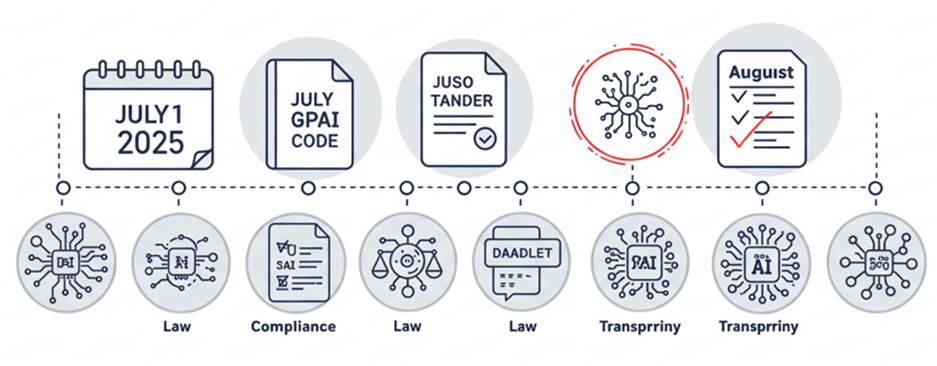
The EU’s new Code of Practice for General-Purpose AI (GPAI) changes the game for Cyber-GRC teams. Published in July 2025 as a practical instrument to help organizations meet the AI Act’s GPAI obligations, the Code focuses on transparency, safety & security, and copyright, and it will strongly influence what regulators expect from providers and users of large, general-purpose models.
Below I turn that policy into a runnable playbook — what Cyber-GRC teams must own now, and a concrete 90-day sprint to get audit-ready.
📌Why this matters now
The Code of Practice was published by the European Commission in July 2025 as a voluntary industry tool to help comply with the AI Act’s GPAI provisions.
Core GPAI obligations under the AI Act take effect 2 August 2025.
The Commission also released a mandatory training-data summary template to standardise how providers describe the data used to train GPAI models; the template and disclosure requirement are part of the implementation steps announced in July 2025.
These developments mean cyber security and GRC teams must deliver reproducible artefacts (model cards, training-data summaries, adversarial test records, incident workflows) that regulators and auditors can verify.
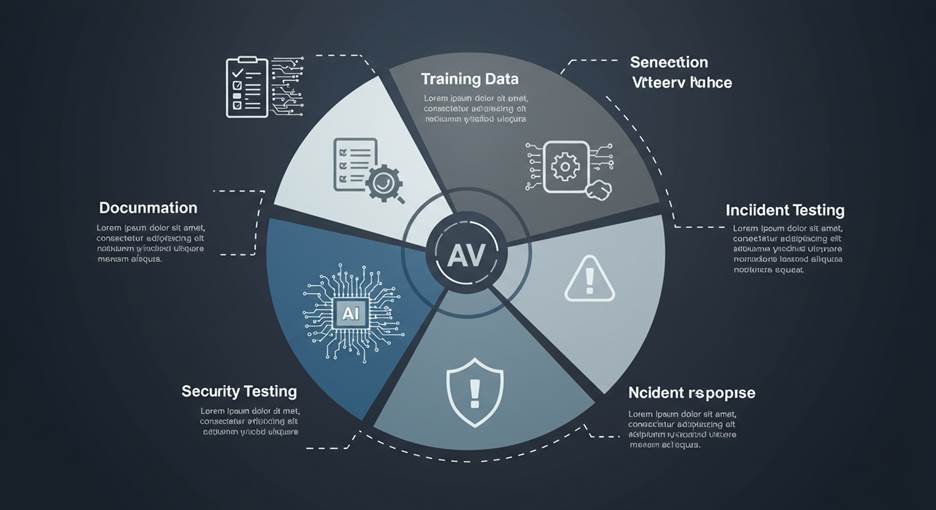
📌Five operational controls Cyber-GRC must own (immediately)
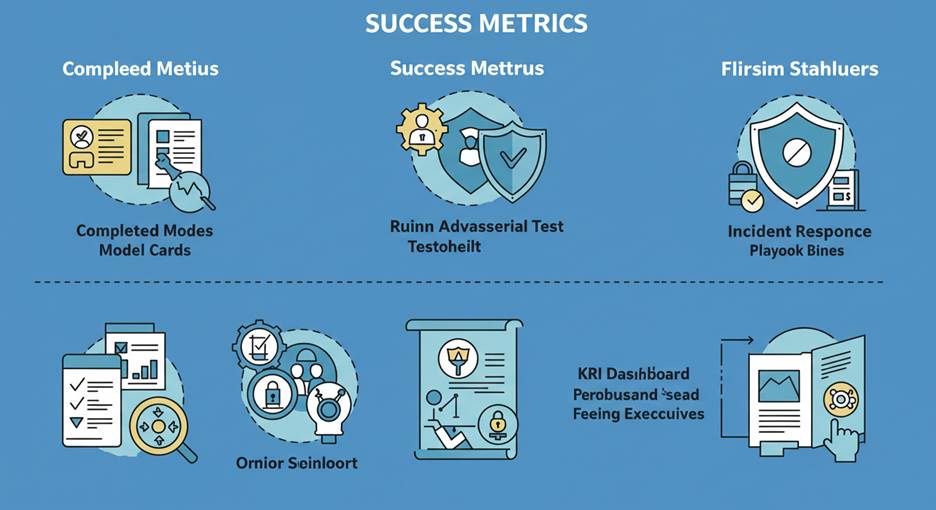
Model documentation & inventory Maintain a central catalogue of every GPAI model in use (internal, vendor, modified/open models), with a living model card, version history, and deployment context (business function, data flows, exposure). This is the single source of truth for audits and investigations.
Training-data summaries & provenance Use the Commission’s summary template (or an aligned internal template) to capture what training data was used, how it was sourced, and any copyright or licensing checks performed. Track modifications and fine-tuning separately.
Security-by-design controls & adversarial testing Define baseline security controls (authentication, access control, monitoring, rate-limits, supply-chain checks) and run regular adversarial tests / red-team exercises focused on model manipulation, prompt attacks, and data poisoning.
AI incident & escalation playbook Extend incident response to cover AI-specific incidents (e.g., model hallucinations with safety implications, copyright infringement claims, exfiltration via model outputs). Define severity thresholds, reporting lines (legal / PR / regulator), and regulatory reporting timelines.
KRI/KPI & audit evidence Publish measurable KRIs (e.g., % of models with up-to-date model cards, frequency of adversarial tests, time to revoke/patch model endpoints, % of models with completed copyright/IP risk assessment) and ensure evidence is exportable for regulators and auditors. Where possible automate the measurement and bind evidence to control owners
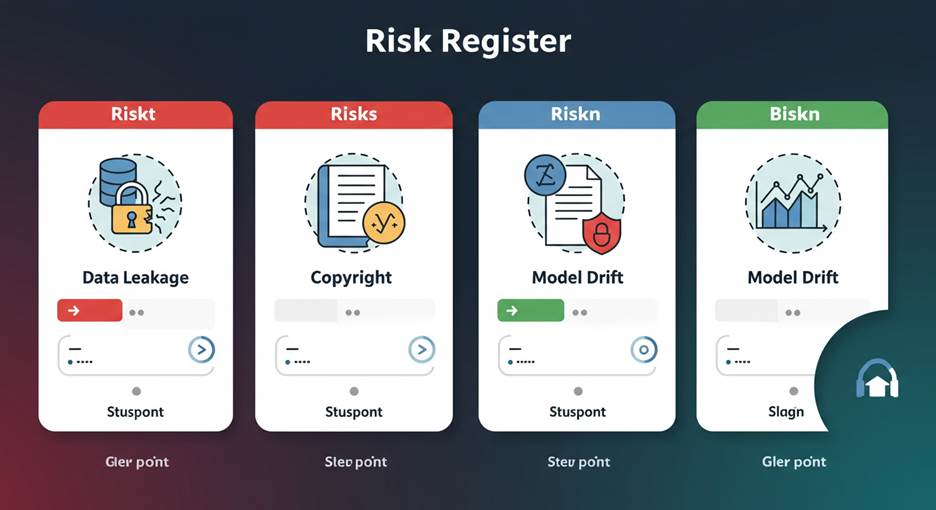
Risk: Unauthorized data leakage from model outputs. Controls: Output filtering, usage logging, access controls, prompt sanitisation. KRI: % of flagged outputs detected by filter; time to revoke model endpoint access.
Risk: Copyright exposure from training data. Controls: Training-data inventory, licensing checks, legal review. KRI: % of training datasets with completed copyright assessment; # outstanding issues.
Risk: Model drift causing safety failures. Controls: Drift monitoring, scheduled retraining governance, rollback procedures. KRI: Drift metric threshold breaches per month; MTTR (hours) to rollback.
Data Science / MLOps (owner): model lifecycle, retraining, technical fixes.
Legal / IP (owner): copyright checks, licensing decisions, regulatory communications.
Procurement (owner): vendor attestations, contractual clauses for AI models.
Cross-functional governance boards are useful, but operational ownership must be clear. Weekly or fortnightly syncs turn policy into practice.
📌What “Good” looks like in 6 months
All critical GPAI models have living model cards and training-data summaries.
Regular adversarial tests and a rehearsed AI incident response.
Measurable KRIs feeding a monthly AI risk digest for executives and the board.
Contractual clauses that require vendors to provide model transparency and security attestations.
📌Final thought
The EU’s GPAI Code and the AI Act don’t merely add paperwork — they raise the bar for what “reasonable” AI risk management looks like. Cyber-GRC teams that move today from policies to reproducible artefacts (model cards, training-data summaries, adversarial test records, incident playbooks) will not only reduce regulatory risk — they’ll build trustworthy, resilient AI operations.
Comments and experiences welcome — what’s the biggest AI risk you’ve uncovered in your organisation so far?
References & Citations
Below are the key sources referenced in this article and the official links to access the full EU General-Purpose AI (GPAI) Code of Practice / guidance and related materials — with a short note on what you’ll find at each resource.
Official Code of Practice (European Commission — Code page) — Full Code of Practice text and context (structure, chapters, purpose). Digital Strategy EU
Commission press release — “General-Purpose AI Code of Practice now available” — Official announcement and summary of timing (GPAI rules entry into application). European Commission
Training-data summary template & explanatory notice (downloads: PDF / DOC) — The Commission’s public template and explanatory note for summarising the data used to train GPAI models (essential for compliance artefacts). Digital Strategy EU+1
BSA / industry commentary — analysis of practical challenges and timelines for providers. Summary: Industry associations’ viewpoints on the timeframes and practicalities of implementing the training-data template and other requirements — useful to understand sector concerns and operational trade-offs. BSA
European Commission — “The General-Purpose AI Code of Practice” (Digital Strategy / AI Office). Summary: The official Code of Practice (published July 2025) describing the three chapters (Transparency, Copyright, Safety & Security) and providing model documentation guidance and tools to help comply with the AI Act. Digital Strategy EU
European Commission press release — “General-Purpose AI Code of Practice now available” (Commission Press Corner, July 2025). Summary: Commission announcement confirming publication of the Code and noting the AI Act GPAI rules will enter into application on 2 August 2025; explains intent and next steps. European CommissionDigital Strategy EU
Commission news — “Commission presents template for General-Purpose AI model providers to summarise the data used to train their model.” Summary: Announces the Commission’s standardized training-data summary template, the practical format GPAI providers should use to disclose training data information. Essential for GRC teams building templates and processes. Digital Strategy EU
WilmerHale briefing — “European Commission Releases Mandatory Template for Public Disclosure of AI Training Data.” Summary: Legal analysis of the training-data summary requirement, its effective date (Aug 2, 2025), and transitional arrangements for models already on the market — useful context for compliance timelines. WilmerHale
Mayer Brown / Crowell / Skadden briefings (legal firms) — various summaries of the Code and compliance timeline. Summary: Practical legal guidance explaining the compliance timeline (obligations apply from Aug 2, 2025; enforcement powers phased in later), and breakdowns of the transparency, safety and copyright chapters. These are helpful to translate policy into obligations for operations. Mayer BrownCrowell & Moring – HomeSkadden
News coverage — Financial Times / AP / ITPro reporting on signatories and industry reactions. Summary: Reporting on which major providers are engaging with (or resisting) the Code, and broader industry reaction — useful for procurement and vendor-risk conversations. Financial TimesAP NewsIT Pro