1️⃣ The Evolving Role of the SOC
Security Operations Centers (SOCs) are the command hubs of cybersecurity — monitoring threats, investigating incidents, and safeguarding business continuity.
However, as attack surfaces expand across hybrid clouds, mobile endpoints, and IoT networks, the traditional SOC model is under immense pressure.
Analysts are buried in thousands of alerts daily, many of them false positives. The result? Alert fatigue, burnout, and slower response times.
The modern SOC must evolve — from reactive monitoring to intelligent, predictive defense — and that’s where Artificial Intelligence (AI) steps in.

2️⃣ How AI is Transforming the Modern SOC
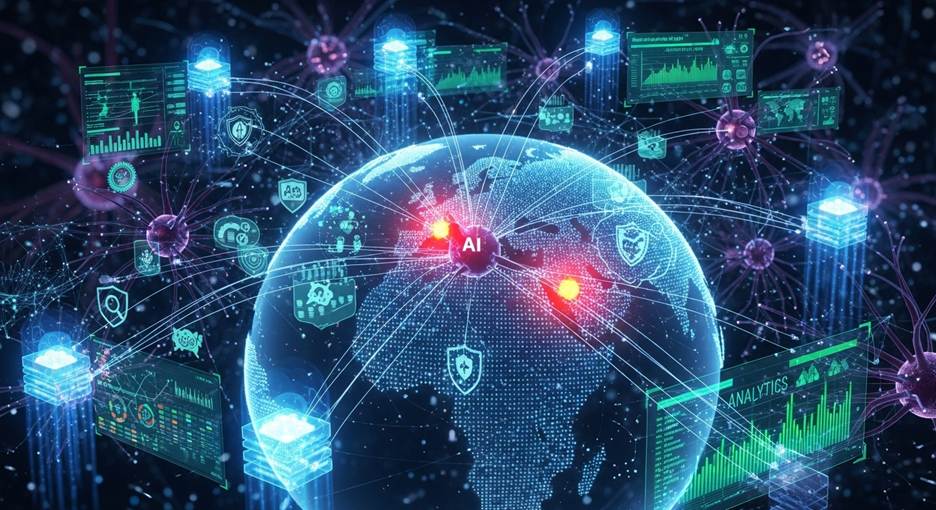
AI isn’t just a buzzword in cybersecurity — it’s a force multiplier. Here’s how AI and machine learning (ML) are revolutionizing SOC operations:
- Anomaly Detection at Scale:
ML algorithms can process billions of events in real time, identifying patterns and anomalies far faster than human analysts. - Alert Triage and Prioritization:
AI can correlate alerts across SIEMs, EDRs, and network sensors, helping analysts focus on the most critical incidents. - Intelligent Threat Hunting:
Predictive analytics enable proactive hunts based on evolving attacker behaviors and MITRE ATT&CK frameworks. - Automated Response via SOAR:
With AI-enabled playbooks, SOCs can automatically isolate endpoints, block IPs, or gather forensic evidence — within seconds.
The shift is from a human-led, tool-supported SOC to a machine-augmented, analyst-driven model.
3️⃣ Human-in-the-Loop: Why Analysts Still Matter
Despite growing automation, humans remain the brain and conscience of the SOC.
AI excels at pattern recognition and automation, but it lacks contextual understanding, ethics, and creativity.
A resilient SOC integrates the best of both worlds:
- AI handles repetitive tasks — alert filtering, log correlation, and data enrichment.
- Humans apply judgment — assessing business impact, refining rules, and leading investigations.
The future isn’t “AI replacing humans” — it’s “AI empowering humans.”

4️⃣ Governance, Risk, and Trust in AI-Driven SOCs
With great automation comes great responsibility.
AI introduces new governance challenges — algorithmic bias, explainability, and accountability.
To maintain trust, organizations should:
- Establish AI governance frameworks defining data sources, model training, and validation processes.
- Ensure auditability of AI decisions — every automated alert or action should be traceable.
- Regularly test AI outputs for false negatives and bias, especially in critical environments.
A trustworthy SOC is not only intelligent but also transparent.

5️⃣ The Future: Autonomous, Predictive, and Resilient
By 2027, Gartner predicts over 60% of SOCs will use AI-assisted threat detection and response.
The most successful ones will leverage AI not as a replacement for human expertise but as a strategic enabler for resilience, speed, and foresight.
Organizations that embrace AI responsibly today will lead tomorrow’s cybersecurity landscape.

👉 Call to Action
AI has already changed how we think about cyber defense.
The question is no longer “Should AI be in your SOC?” but “How responsibly are you integrating it?”
Let’s shape the future of intelligent, ethical, and resilient SOCs — together.
What’s your take? How ready is your SOC for AI-driven defense?
#AI #CyberSecurity #SOC #ThreatDetection #DigitalResilience #Automation

Leave a Reply